
Call a local advisor
+86 186 1196 4400Email our team
[email protected]Tour Beijing Journal
Dear Travellers, We’d like to have the following quick guide to remain...
Dear Travellers,
We’d like to have the following quick guide to remain updated for the benefit of new visitors coming to Ming Tombs in Beijing. If anybody having used the piece finds necessary updates, please leave a message or feedback. Thanks!
Before we talk about how to visit Ming Tombs, people are more interested in knowing whether Ming Tombs are worth visiting. Well, as far as I know, people are quite divided on this. Some dislike; some feel they are ok and others say they are a must see. So different people with different cultural and social backgrounds have their own different opinions on the question.
But in my opinion, generally it is quite worth having a glimpse on a combined journey to or back from the Great Wall or Summer Palace since the location of Ming Tombs is quite accessible on the way to the sections of the Great Wall of China – Juyongguan, Badaling and Mutianyu, and also not far from Summer Palace.
Of course, their accessibility is not the only reason for being worth visiting. Listed as a UNESCO world cultural heritage, Ming Tombs provide people a kind of real experience. That tells why this place is a popular place for native Chinese, especially those who are attracted by its history.
If you are going to visit the Tombs, then how to visit them? What homework you should do before you come close to them? Maybe the following Ming Tombs travel tips will be useful for you:
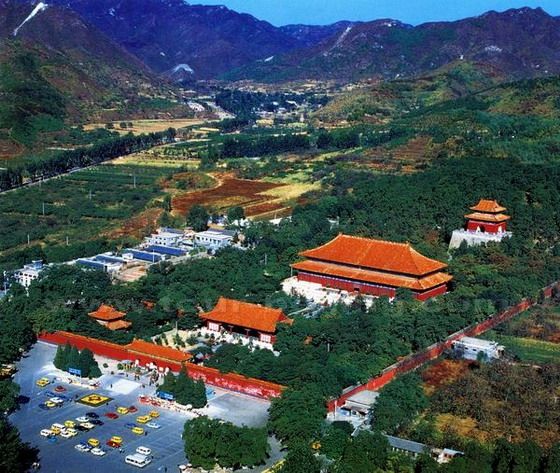
Ming Tombs here refers to the 13 tombs in Ming Dynasty where 13 out of 16 emperors in Ming Dynasty were buried successively there. There were totally 16 emperors in Ming Dynasty (1368 - 1644 AD).
Of all the 13 Ming Tombs, at present only 3 Ming Tombs are open to the public, namely Dingling, Changling and Zhaoling ( “ling” literally means “Tomb” in Chinese). So before you are going to visit Ming Tombs, you’d better know which of the 3 tombs you should visit, which are located separately quite a distance. The three tombs are also a little different in terms of ticket prices and value.
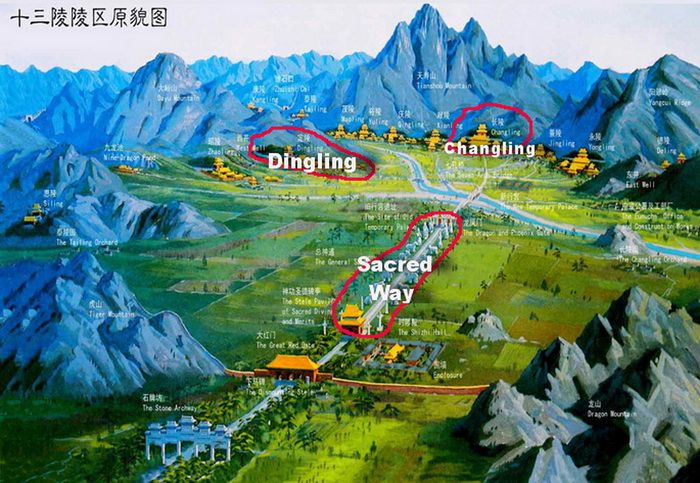
Of the 3 Ming Tombs opened to the public, only Dingling ( often called Underground Palace) has been excavated. There is down a long staircase into a chamber with some stone thrones and a few large plain red boxes which are the burial caskets in the so called underground palace.
Because all the 3 tombs are located separately quite a distance, usually you only have time to visit one of the three tombs. So which one? If you have no problem with your knees and feet, and are fairly good at walking, you are advised to visit Dingling – the underground Palace.
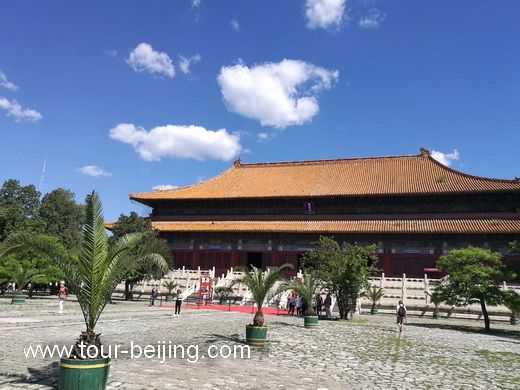
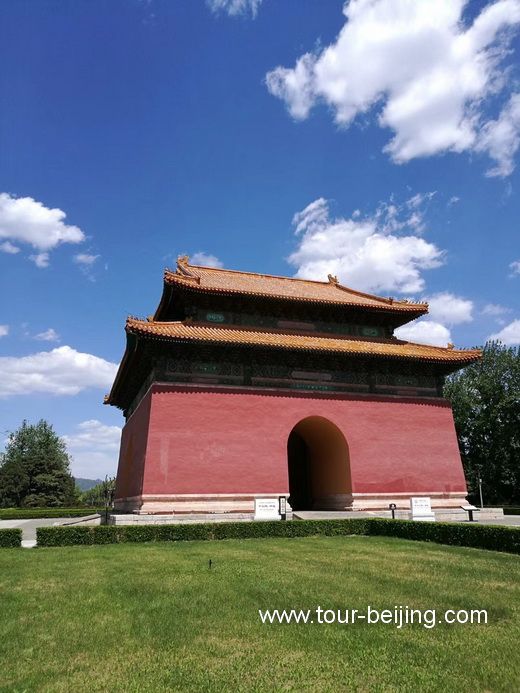
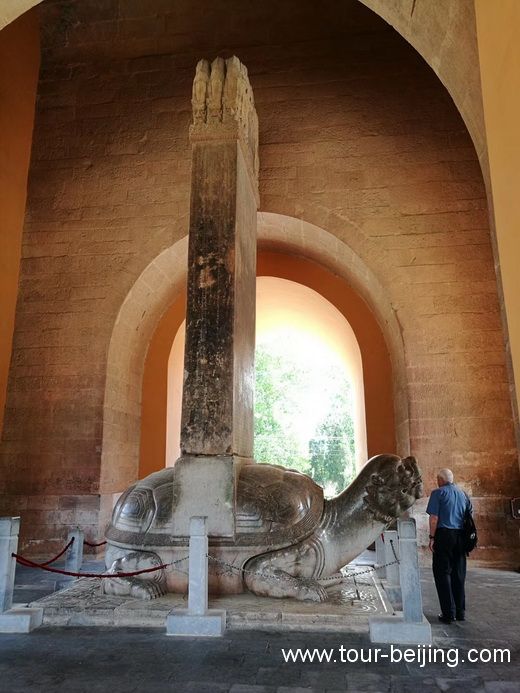
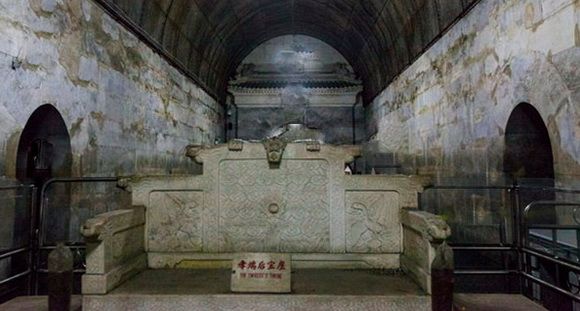
You have a long walk from the Dingling Entrance before you get to the Tomb itself, where you walk 8 flights of stairs down. The walk to the tomb can be hard and long during high season, but normally takes about 15 minutes.
If you are wheelchair users or have some difficulty in walking, just forget Dingling, and choose Changling instead. Changling is the largest tomb of all the 13 Ming Tombs. There are a wide collection of artifacts and valuables unearthed from the tombs.
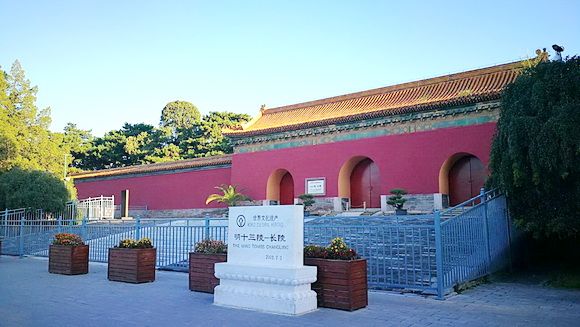
Changling is the tomb where buried the Third Emperor Zhu Di with his queen Nee Xu. Changling is not excavated yet. But its grand hall on the ground is worth visiting. The construction of the hall started in 1409 and finished in 1427. As for Zhaoling, you can simply skip it since it is almost renovated.
For me, the best part of Ming Tombs tour is the walk down Sacred Way which is lined with large statues that are several hundred years old. These are huge statues of lions, camels, elephants, etc, and as well as stone statues of officials and officers, lining up on both sides of the Sacred Way.
To visit either Dingling or Changling, you'll first pass by the Sacred Way, or "Spirit Way" leading into the complex of the 13 tombs.
Though the Sacred Way is supposed to be 7.3km. But don't be afraid of its length. The highlight of the Sacred Way which you have to pay the entrance ticket to enter is only 800 meters long. So it is a 800-meter long walk.
Basically you enter the southern gate and exit from the northern gate. So if you have extra time, you are recommended first to visit the Sacred Way.
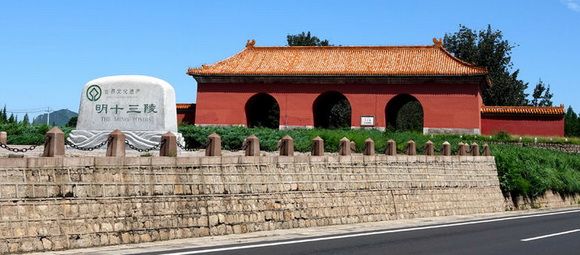
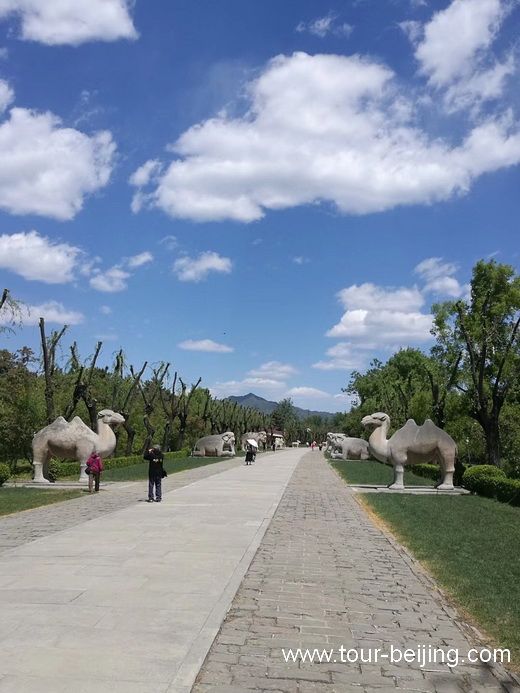
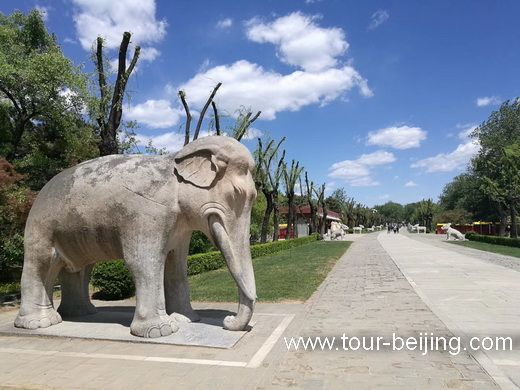
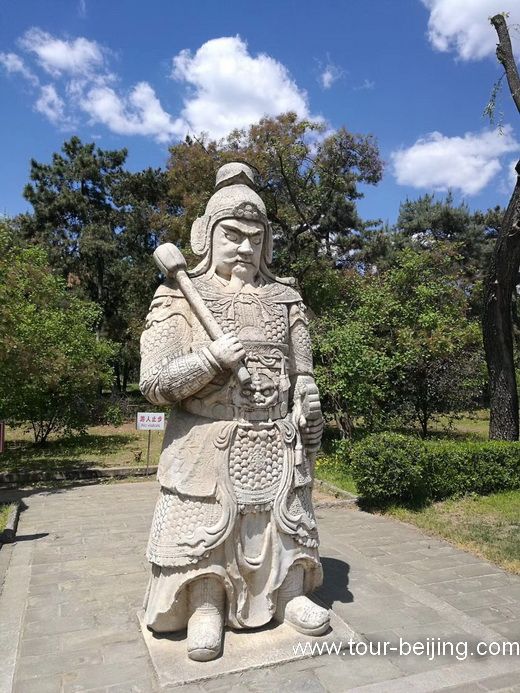
The Sacred Way is part of the Ming Tombs complex. Sacred Way means the road leading to heaven. The Emperor, known as the Son of the Heaven, who descended from Heaven to his country through the Sacred Road, also would return to Heaven through this way.
Inquiry: 010-60761424, 010-60761888
Sacred and Ming Tombs are located in Changping District, about 50km north of Beijing.
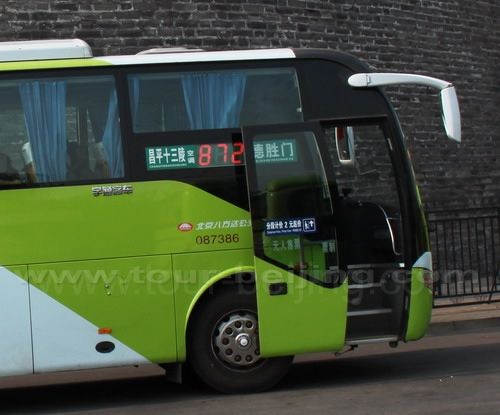
Basically you have the money-saving option to take Bus 872 to directly reach the Ming Tombs from Deshengmen Bus Terminal in the downtown Beijing.
The Bus 872 starts from Deshengmen Bus Station which is located on the north square of Deshengmen Arrow Tower (德胜们箭楼) lying on the mid-way of the northern second ring road. It is worth getting up earlier to catch an early morning Bus 872 for Ming Tombs.
Several buses can bring you to the Deshengmen Bus Station. But the bus system in Beijing could be daunting even for the local Beijingers. It is advisable to take the Subway Line 2 to reach Deshengmen Bus Station. The the closest subway station to Deshengmen Bus Station is Jishuitan (积水潭) of the loop-type Subway Line 2.
You get off at the station of Jishuitan (积水潭), exit from the Exit A. Then walk along the sidewalk in the east direction for about 450 meters, soon you will see a high tower – the Deshengmen Arrow Tower. Deshengmen Bus Station is just below the northern side of the tower.
The compound of Deshengmen Arrow Tower is within a roundabout. So you have to cross a road to reach the bus station. You have to be careful crossing the road since the road has no traffic light at the time of my writing.
By the way, on your 450-meter walk from the subway station of Jishuitan to the Deshengmen Arrow Tower, you will pass alongside the Deshengmenxi ( "xi" means "west") Bus Station which is different from Deshengmen Bus Station, and you just ignore it!
You will be also distracted by some privately owned buses or mini-buses operated in the name of official Badaling-bound buses. We strongly suggest you take the official buses within the Deshengmen Bus Station for safety and reasonable price.
Don’t be surprised if you find the queue in front of the bus 872, especially on the weekends or national public holidays.
Bus 872 is below the west side of Deshengmen Tower
Sacred and Ming Tombs are located in Changping District, about 50km north of Beijing. Just follow your GPS along G6 Beijing-Tibet Expressway. And after arriving at the Changping Xiguan Roundabout ( 昌平西关环岛), turn north to Jingyin Road ( 京银路) and turn right at the traffic light 500 meters later to Changchi Road (昌赤路).
Along the way, you will pass the Stone Archway (石牌坊), the Sacre Way of the Ming Tombs ( 神路), the Seven-Arch Bridge and the T-junction. Then go straight to Changling Tomb, turn left to Dingling Tomb and Zhaoling Tomb.
The most common is blended with the trip to one of the sections of Great Wall of China – Juyongguan Great Wall, Badaling Great Wall or Mutuanyu Great Wall on an a day trip in Beijing.
Take greater precaution when you go down the 8 staircases to the underground palace at Dingling Tomb.
If you’d like to go from Ming Tombs ( Dingling ) and Badaling or vice versa, you can take the Bus 879 listed below:
1) Dingling Tomb ( Ming Tombs) to Badaling Great Wall
If you don’t want to go the do-it-yourself route and prefer the hassle-free escorted tours, here are some options for guided tours to Beijing:
Share a question or note for this guide. Comments are reviewed before publishing.
Hand-picked routes matched from this article's destination clues, tags, and categories.
Use these attraction notes to connect nearby sights with tours, destination guides, and planning articles.
Continue planning with practical Beijing guides selected from similar places, themes, and travel questions.
Subscribe to receive Beijing travel ideas and tour updates.