
Call a local advisor
+86 186 1196 4400Email our team
[email protected]Tour Beijing Journal
Plan your Beijing hutong tour? Basically a glimpse of the old hutongs in...
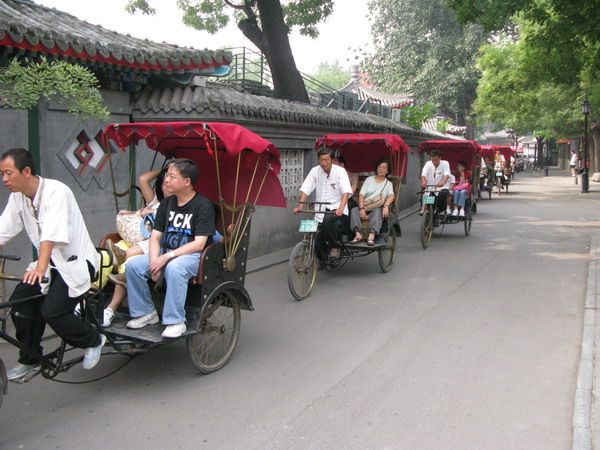
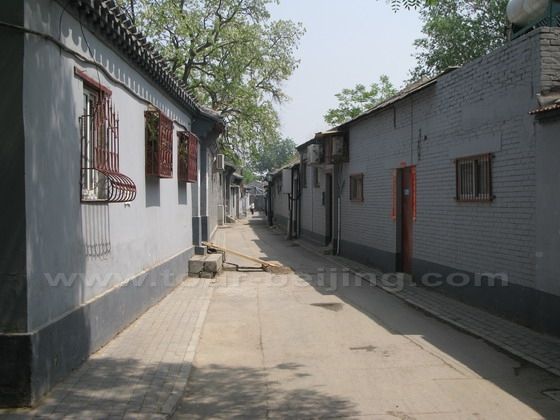
The hutongs in Beijing originated in the Yuan Dynasty (1279–1368) . Today, there are still many old hutong left, kept intact or revamped. A short trip to hutongs helps you have a whole picture of Beijing, both spiritually or physically.
We round up the top 10 hutongs in Beijing, which are often lauded as the most famous representing the authentic old Beijing. Follow us for the virtual tour of these amazing old hutongs, each of which has a story and deep past with strong Beijing flavor.
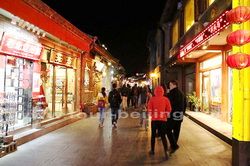
On both side of the street there are plenty of storefronts and vendor’s stalls selling collectibles and art supplies, including the renowned Rongbaozhai, the most prominent shop on the west section of Liulichang.
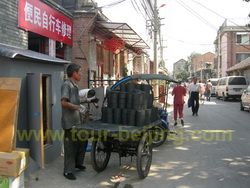
It sells woodblock prints, copies of famous calligraphy, historic paintings (reproductions), and art supplies.
It is one of Beijing’s top art shops and well worth browsing. Actually Rongbaozhai is located on the west section of Liulichang Street. To get to Liulichang Xijie ( the west section of Liulichang Street) on your right side, you have to across the main street.
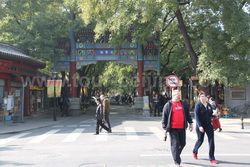
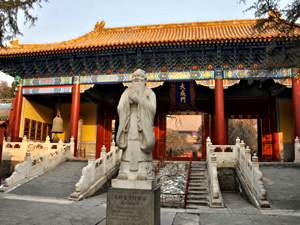
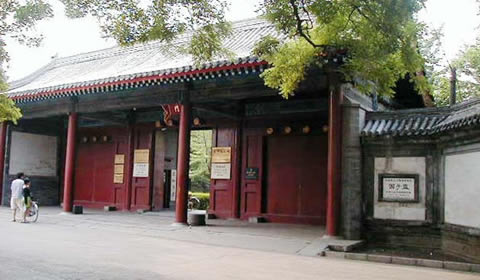
Subway Line 2: get off at Yonghegong (Lama Temple) Station, come out of the station from Exit C (Southwest Exit), and walk south about 500 meters, then you’ll find Chengxian Jie (Chengxian Street) on your right hand and walk westward for 200 meters, and you will find Confucian Temple and Guozijian Imperial College on your right side.
Subway Line 5: get off at Yonghegong (Lama Temple )Station, and come out of the station from Exit D (Southwest Exit).
Maoer Hutong belongs to Jiaodaokou Street, Dongcheng District, Beijing, starting from From Nanluoguxiang in the east, west to Di 'anmen Outer Street.
In the Qing Dynasty, it was renamed Hat Alley (Maoer Hutong ) because of the hat-making workshops scattered along the hutong.
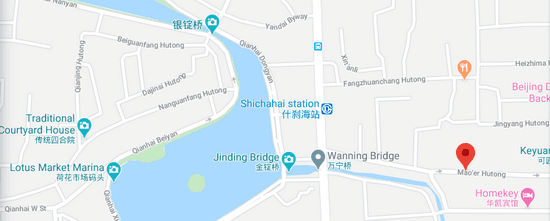
There are many well-preserved courtyards in Maoer Hutong: Maoer Hutong No. 5, Maoer Hutong No.9 (Keyuan Garden), Maoer Hutong No 11(Wen Yuzhai Mansion), Maoer Hutong No. 13 (Feng kuo-chang Former Residence), Maoer Hutong 21 (Wenchang Palace Ruins), Maoer Alley No. 37 (Empress Wanrong's Former Residence), Maoer Hutong 45 (Qing Yamen, security forces of the republic of China), etc.
Juer Hutong is located in the northwest of Dongcheng District of Beijing, starting from Jiaodaokou South Street in the east, reaching Nanluoguxiang in the west. It is under the jurisdiction of Jiaodaokou Sub-district office. It 438 meters long, 6 meters wide, an asphalt pavement. Now most of the north side of the alley has been demolished to build courtyard houses.
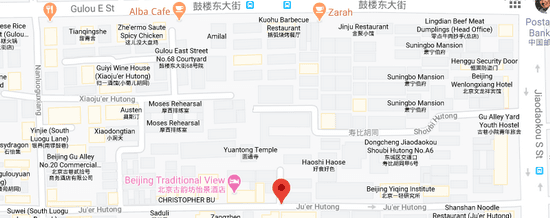
For example, No. 3, 5 and 7 Juer Hutong in Dongcheng were the residences of Ronglu during the reign of the Qing Emperor Guangxu. Number 3 is his former ancestral temple, number 5 is his former residence and number 7 is his former garden. Ronglu later moved to Dongchang Hutong.
Juer Hutong No.7 once served as the Afghan Embassy. Juer Hutong No. 41 was originally a temple.
Perhaps it is just because of its close proximity to the bustling area and its strong taste of history that many foreigners who are infatuated with China but have not yet penetrated into The life of Beijing live in Ju Er Hutong.
More than a narrow alley, Jinyu Hotong ( literally "Goldfish") is like a wide street, 567 meters long, 12 meters wide. It connects Wangfujing Street in the west and Dongdan North Street in the east.
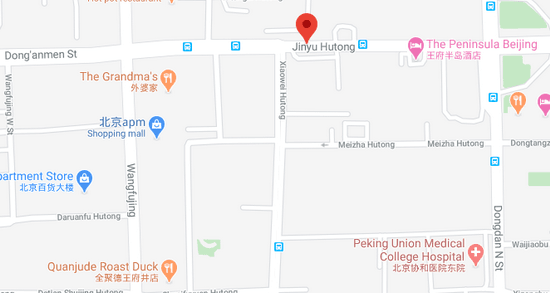
It now actually a commercial street with several luxuary hotels and high-rise buildings. Here you cannot find any flagstone roads nor courtyards.
Address: from Dongdan North Street to Wangfujing Street, Dongcheng District
Attractions nearby : Wangfujing Street and Wangfujing Church (St. Joseph's Wangfujing Cathedral)
Subway: Line 5 to Dengshikou, Exit C
This 1080-meter long hutong was called Xijiangmi Alley and the north of the alley were several central institutions in Ming Dynasty. The alley was renamed "Xijiaominxiang ( Xijiaomin Alley ) in Qing Dynasty.
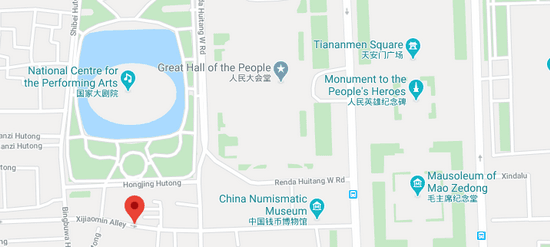
At the end of Qing Dynasty and the beginning of Republic of China, Xijiao Minxiang was also called bank Street.
Today you still can see the old bank buildings - the old site of the Central Bank Peiping Branch, the old site of China Agricultural and Industrial Bank, and the old site of the mainland bank, the old site of Beiyang Commercial Bank (the two were built into the new China Numismatic Museum in 2002 and other cultural relics protection units.
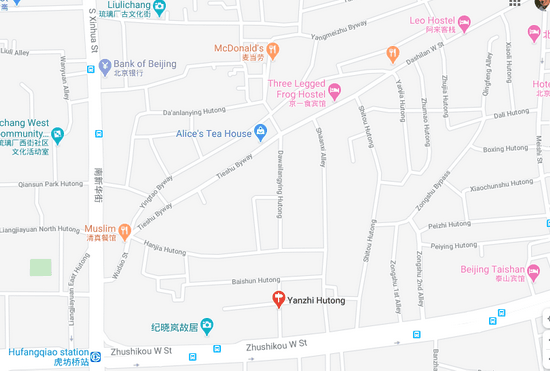
The eight hutongs were rife with brothels before in 1949. So when a man told you he would go to the eight great hutongs, he actually wanted to let you know what he would do instead of going to any of the exact hutongs. In fact, "eight" is an imaginary number here, just to show there are many.
Broadly speaking, the Eight Hutongs refer to a number of hutongs in a large area south of Tieshu Byway, north of Zhushikou West Street, east of South Xinhua Street, and west of Meishi Street.
If you don’t want to go the do-it-yourself route and prefer the hassle-free escorted tours, here are some options for Beijing guided tours:
Share a question or note for this guide. Comments are reviewed before publishing.
Hand-picked routes matched from this article's destination clues, tags, and categories.
Use these attraction notes to connect nearby sights with tours, destination guides, and planning articles.
Continue planning with practical Beijing guides selected from similar places, themes, and travel questions.
Subscribe to receive Beijing travel ideas and tour updates.