
Call a local advisor
+86 186 1196 4400Email our team
[email protected]Tour Beijing Journal
There are many places and landmarks of historical importance in China....
The study abroad programsgive a visitor a completely new perspective of a country to a student. It is a well known fact that travelling is a great opportunity to experience a place. There is no substitute for gaining knowledge about a place than being there. This is why a lot of gap year programs and study abroad programs aim to include an extensive travel itinerary that gives a complete exposure to the culture and history of a place.
When one travels to China to learn Chinese, there are numerous places that date back as far as thousands of years. Since then China has seen numerous changes and visitors from other countries. Amongst the most prominent people who have visited China in the pre-Renaissance era was Marco Polo (1254-1324) who has written about the country extensively in his memoirs.
Marco Polo (1254-1324), Italian traveller and author, whose writings gave Europeans the first authoritative view of life in the Far East.
In his diary, Marco Polo talks about the prowess of Beijing and mentions a bridge which is now called the Marco Polo Bridge. Actually the bridge’s Chinese name is Lugou Bridge. But the bridge is known in the West simply as the Marco Polo Bridge due to Marco Polo’s visit in the 13th century.
The bridge is still called Lugou Bridge in Chinese. Marco Polo saw this bridge on his China visit in the 13th Century AD and he has mentioned it in his chronicles as follows– “Over this river there is a very fine stone bridge, so fine indeed, that it has very few equals in the world.”
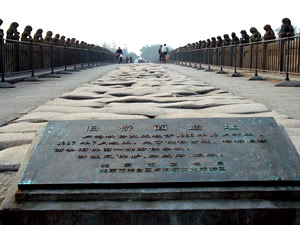
The Marco Polo Bridge lies 15 km in the southwest of Beijing City and it spans the banks of the Yongding River. The historical records of China suggest that this river was initially called Heishui which meant Black Water. Then it was called Lu which meant Black and hence it earns its traditional name of Lugou and from there the bridge has also earned its name.
The bridge was built in the latter half of the 11th Century AD. Its construction started in 1189 and finished in 1193. It has a length of 235 meters and is made of white marble.
It was one of the most majestic bridges of its era. It comprises of 11 arches and many broad piers. This bridge bears the history of Emperor Kangxi on a stone face on one end and the writing of Emperor Qianlong on the other end saying “The moon over the Lugou Bridge at dawn” when translated.
Over the last few years this bridge has attracted not only students doing their Chinese language programsin the country but also engineers and architects from across the globe.
This bridge still stands as robust as ever. The Marco Polo Bridge (Lugou Bridge), is an architecturally significant structure.
This firm structure also has two rows of marble balustrades, each of which has a lion carved over it. Each of the lions has been carved in different ways and styles. There are also figurines of animals like elephants that are found at the end of both sides of bridge depicting these animals as ‘’guards’’ of the bridge.
The Marco Polo Bridge Incident ( or the Lugou Bridge Incident) referred to the battle between China’s army and the Imperial Japanese Army which occured on and around Marco Polo Bridge, officially marking the initiation of the Second Sino-Japanese War (1937–1945), as part of Second World War.
If you don’t want to go the do-it-yourself route and prefer the hassle-free escorted tours, here are some options for Beijing guided tours:
Share a question or note for this guide. Comments are reviewed before publishing.
Hand-picked routes matched from this article's destination clues, tags, and categories.
Use these attraction notes to connect nearby sights with tours, destination guides, and planning articles.
Continue planning with practical Beijing guides selected from similar places, themes, and travel questions.
Subscribe to receive Beijing travel ideas and tour updates.