
Call a local advisor
+86 186 1196 4400Email our team
[email protected]Tour Beijing Journal
Plan your Henan tour? Henan Province is situated in Central China. Henan...
Getting to Kaifeng is relatively convenient. You may take a bus from Zhengzhou ( one and half hour ), Luoyang ( three hours). Or you may take an overnight train from Beijing West Tran Station (12 hours ), Shanghai ( seven hours).
The city of Kaifeng within the ancient city wall is compact and walkable. Like a grid pattern city of Xian and Pingyao, Kaifeng has its own axis of Zhongshan Road lined up with major attractions like Temple of the Chief Minister, Kaifeng Fu, Kaifeng Museum, Dongda Mosque, Former Site Kaifeng Synagogue, Shanshangan Guild Hall, Longting Park, Qingming Garden and City Wall.
I've rounded up the top 10 attractions in Kaifeng. September and October are the best time to visit Kaifeng with chrysanthemum blossoms everywhere, the city flower in Kaifeng.
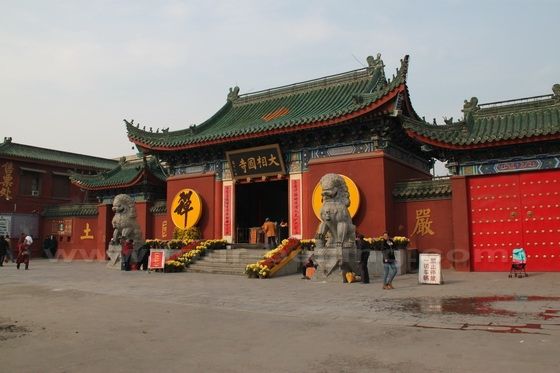
Temple of the Chief Minister was in its prime during Northern Song Dynasty (960-1126), the monks totaling 10,000, 64 subordinate temples and an area of 540 mu ( 35 hectares ), an imperial temple for Northern Song Dynasty.
The present temple is mainly composed of the Heavenly Kings Hall, Mahavira Hall, the Octagonal Glazed Hall, Sutra Depository Building and the Four-Faced Thousand Eye Guanyin within the Arhat Hall.
Entrance Fee: RMB 45 Opening Hour: 08:00 - 18:30 Add: 36 West Section of Ziyou Road, Gulou District, Kaifeng 鼓楼区自由路西段36号 Tel: 0378 - 5665090 How to get there Take Bus 1,2,5,8 or walk from Kaifeng Bus or Train Station ( 2. 5km).
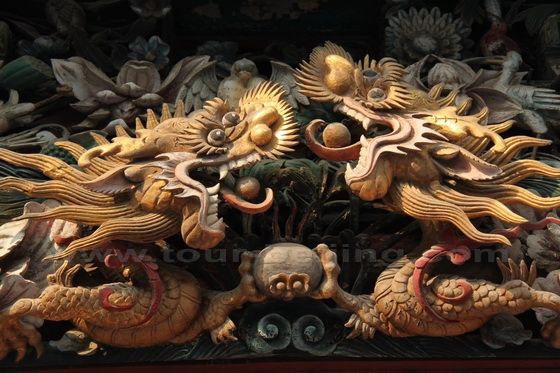
The past 200 years have seen Shanshaangan Hall going through numerous ups and downs. What we we see today is a small part of the orginal guild. Or more exactly it is the only remaining Guangdi Temple building inside the original guild hall. The whole temple architecture is rife with exquisite carvings out of stone, brick and wood, which vividly tell the Buddhist stories and folk tales with great artistic value.
The remaining Guangdin Temple is mainly composed of 7 parts- A huge screen wall, Opera Tower, Bell and Drum Tower, East Wing and West Wing Halls, Traditional Pailou (decorated archway), the Great Hall.
Entrance Fee: RMB 30 Opening Hour: 8:00 - 18:30 Add: Xufu Street, Kaifeng. 开封市内徐府街 How to get there Take Bus 1,13,18 and 31 or walk from Temple of the Chief Minister
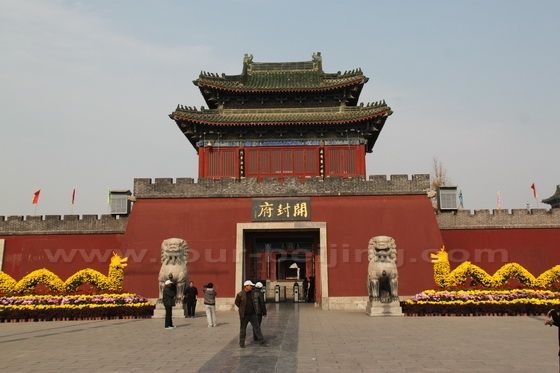
Though Kaifeng Fu is a bit of historical kitsch, often packed with domestic tourist groups, it is still worth your experiencing Song Culture for a 40-minute short trip if you can have the time to spare. This Song Dynasty government office model takes an area of 4 hectares with 50 buildings and halls. You can visit government offices, prisons, imperial examinations, Taoism and imperial life.
Entrance Fee: RMB 60 Opening Hour: 8:00 - 18:30 Add: North Bankof Baogong Lake, Gulou District, Kaifeng 鼓楼区包公东湖北岸 How to get there Take Bus 1,9
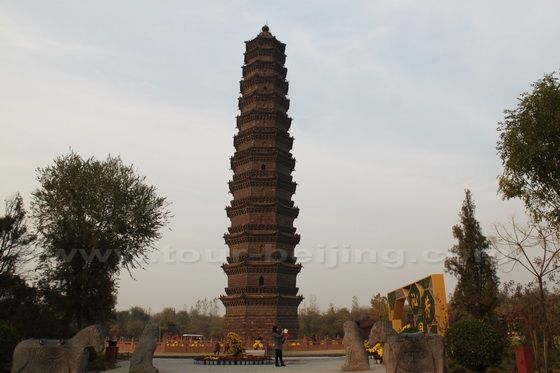
It elegantly stands on the park, slender, a 55m high brick tower coated with rust-color glazed tiles, hence the name of Iron Pagoda. There is an inside narrow stairs ascending to the top for entrance fee RMB 30.
Entrance Fee: RMB 40 Opening Hour: 9:00 - 20:00 Add: 210 Beimen dajie, Kaifeng 北门大街210号 How to get there Take Bus 1, 3, 6,20
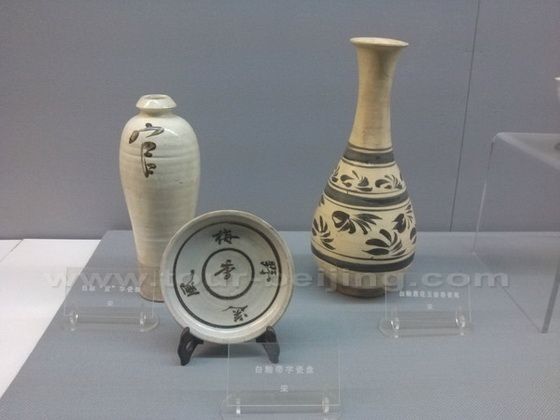
It has an display area of over 5000 square meters with 13 halls. It has a collection of over 50,000 artifacts and 50,000 professional books. Notably, you will see archaeological finds, woodblock prints and more.
Entrance Fee: Free ( closed on Monday ) Opening Hour: 9:00 - 17:00 Add: 26 Yingbin Road,Kaifeng How to get there Take Bus 1
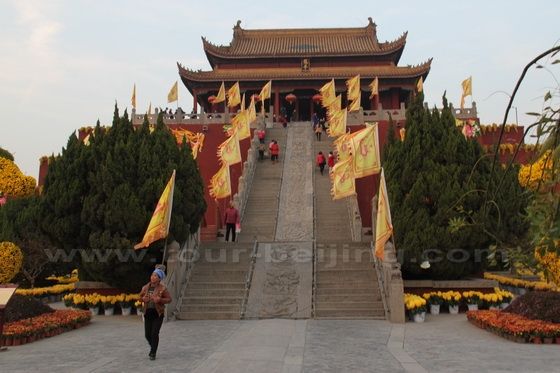
A flight of 72-steps leads up to the platform of the terrace with stone balusters on both sides. In the middle of the flight of steps are cloud-dragons. The Palace Hall atop the terrace is a wooden structure with double-gable roofs. The terrace is fenced with stone balusters. People have a good view of the surrounding scenery – the downtown, Qing-Ming Street and the two lakes. The terrace is aperfect place to view the sunset with beautiful glows.
The building of the Dragon Pavilion dates back to to 1692, the 31th year during the reign of Kangxi Emperior in Qing Dynasty ( 1644-1911). Originally known as Wanshou Pavilion, it was built on the coal hill of the former palace buildings of King Zhou in Ming Dynasty (1638-1644). It housed the emperor tablets for the local officials to pray. Later the Coal Hill wad renamed Dragon Pavilion Hill, hence the name for Dragon Pavilion.Kaifeng is the ancient capital city for 8 dynasties with their palaces successively built on the location of the present Dragon Pavilion and the two lakes. The first man who chose this place with fengshui that prospered for 0ver next 1200 years was Li Mian, the local governor in Tang Dynasty who had moved his office building from Shanqiu to the present Kaifeng in the year of 781 , thus starting the axis of the ancient Kaifeng for over 1200 years.
Entrance Fee: Free ( closed on Monday ) Opening Hour: 9:00 - 17:00 Add: at the northern end of Zhongshan Road, Gulou District, Kaifeng 河南省开封市鼓楼区中山路北段 How to get there Take Bus 1,15
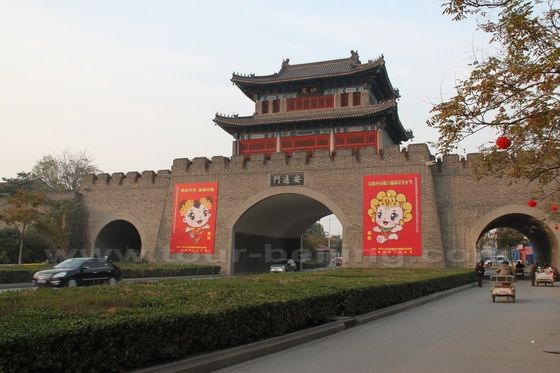
In 960, Kaifeng was dedicated as capital of Northern Song Dynasty which lasted 168 years with 9 emperors. The 168 years found the city wall in Kaifeng developed into Outer Wall, Inner Wall and Imperial Wall, massive and magnificent. The present city wall was the remains of the city wall renovated in Qing Dynasty featuring the building style of Ming and Qing dynasties.
Entrance Fee: Free Opening Hour: all day
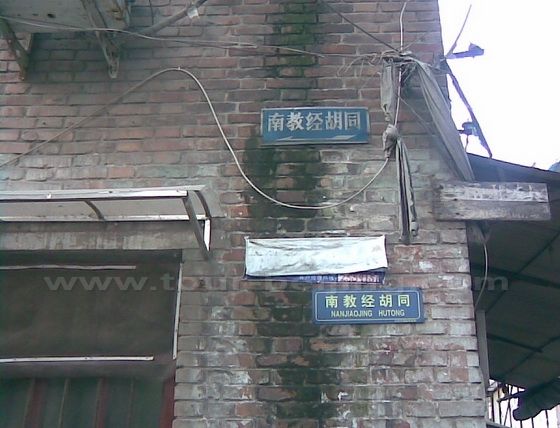
The synagogue was rebuilt in 1279 (Yuan Dynasty) and 1461 ( Ming Dynasty). Li Zicheng ( 1606–1645), a Chinese rebel leader who overthrew the Ming Dynasty, led his army attacking Kaifeng. In 1642, his army made the breaches of the Yellow River dykes by both sides and had Kaifeng heavily flooded and thus ended the siege of Kaifeng and killed over 300,000 residents in Kaifeng, destroying the Jewish neighborhood of Jewish people. Again in 1841, the synagogue was turned to be used to protect the city Kaifeng threatened by the the breaches of the Yellow River dykes. With the last chief Rabbi passed away in 1905, the synagogue gradually disappeared from the world stage.
Traditionally, when Chinese lunar new year ( Spring Festival ) comes, families would paste new year paintings on their door frames and houses with the prints of new year pictures. New year paintings represent a good luck and fortune to say goodbye to the past year and welcome the new year. New year pictures are kinda of unique Chinese traditional folk culture.
Today many people would buy the prints of mass-produced new year paintings from the factories. But still many people and collectors prefer to buy hand-made new year paintings. The Zhuxian Town woodblock new year paintings are one of the most famous man-made new year paintings in China.
The woodblock new year paintings in Zhuxuan Town is an untangible cultural heritage in China. It has been on the verge of extinction due to the new printing technology. Recently the governments at all levels have allocated funds to support and develop the craft of man-made new year paintings.
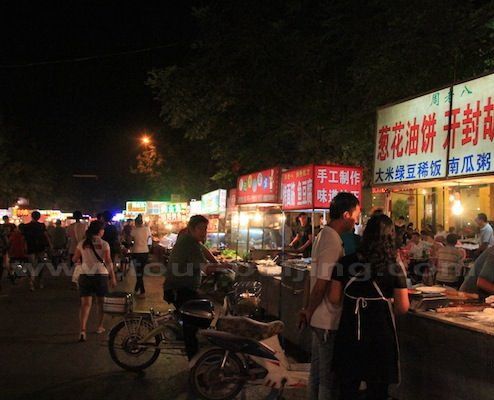
You may have a bite of Muslim kebabs, cold noodles, peanut cakes and sip almond tea, and the list could be much longer.
Share a question or note for this guide. Comments are reviewed before publishing.
Hand-picked routes matched from this article's destination clues, tags, and categories.
Use these attraction notes to connect nearby sights with tours, destination guides, and planning articles.
Continue planning with practical Beijing guides selected from similar places, themes, and travel questions.
Subscribe to receive Beijing travel ideas and tour updates.