
Call a local advisor
+86 186 1196 4400Email our team
[email protected]Tour Beijing Journal
Are you in the process of arranging your Lhasa tour or Tibet tour? Tibet is...
Are you in the process of arranging your Lhasa tour or Tibet tour? Tibet is difficult to explore on a short trip since it is quite huge in size, the second largest provincial-level region in China, just after Xinjiang Uyghur Autonomous Region.
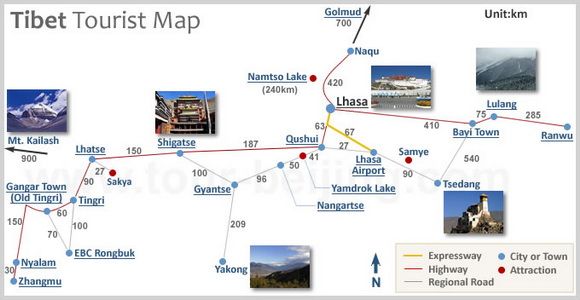
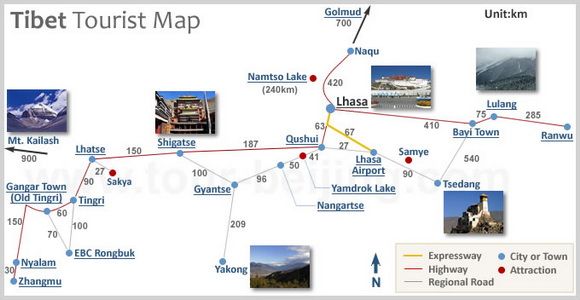
Basically Tibet is officially classified into 6 tourism zones: 1) Lhasa Historical and Cultural Center Tourism Area; 2) Mt. Everest Eco Tourism Area;3) Linzhi (Nyingchi) Forest Eco Tourism; 4) Shannan Yalong River Cultural Scenic Area; 5) Ali Holy Mountains and Lakes Area; 6) Nanqu Grassland Eco Tourism Area.
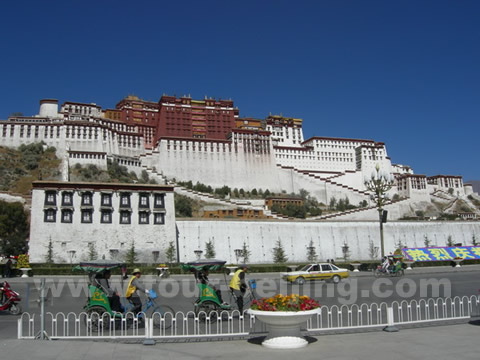
This area is simply called Lhasa Area. Lhasa Area is the most visited place in Tibet. First time visitors coming to Tibet cannot afford to miss the capital city of Tibet. A general Lhasa tour normally takes you approx. 4-5 days, visiting a handful of impressive attractions such as Potala Palace, Bahkhor Street, Sea Temple…
Dubbed as “Swiss Landscape”, Linzhi boasts the most beautiful mountain in China – Namcha Barwa or Namchabarwa and the most beautiful glacier – Midui Glacier and Lulang Forest.
Short for Ali Area, this region is a mecca for Tibetan Buddhists. Circling the holy mountain – Mount Kailash is the must-do buddhist event for many local Tibetans.
It boasts the most scenic travel route of the all the tourism zones where you will see the most beautiful mountain in China – Namcha Barwa in Lulang and the most beautiful glacier in China – Midui Glacier in Ranwu.
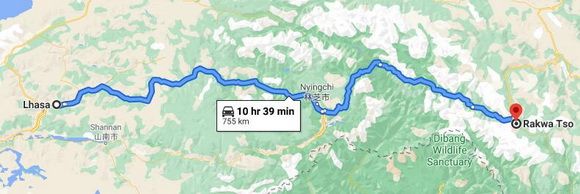
We made a 4-wheel drive trip from Lhasa to Ranwu (Rakwa Tso) last October and the amazing driving experience still lingers in my mind. Well, follow me to drive cross the dreamland again!
We drive eastwards along the Chuanzang Highway (Sichuan Tibet Highway). Completed in 1958, the Chuanzang Highway is 2115km long starting from Chengdu, which is also part of the 5476km National Highway No.318 starting from Shanghai to Zhangmu Town.
Lhasa River, the mother river of Lhasa, accompanies us on our left side running down from the south side of Nyainqêntanglha range. Lhasa River is one of te five major tributaries of Yalong Tsangpo River with a total length of 551 km. Lhasa River passes the south area of Lhasa City from east to west, then runs south and meets Tsangpo River at Qushui.
The autumn view of the crystal waters of Lhasa River with the bald and dark mountains reflected on the river.
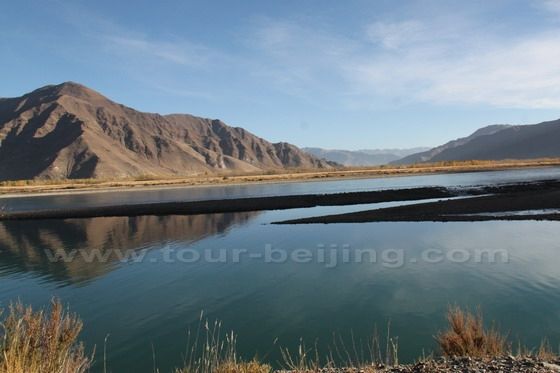
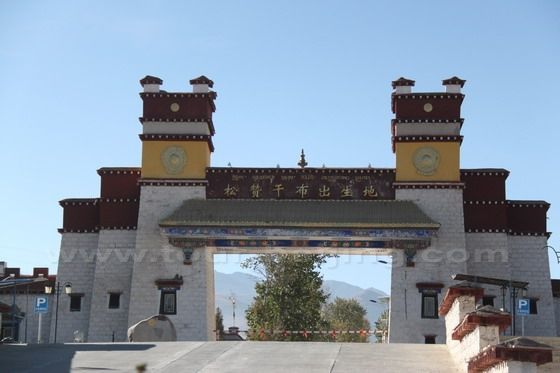
The autumn view of the crystal waters of Lhasa River At the distance of 69km from Lhasa(within Maizhokunggar County), we get off at the site of the birth place of Songtsan Gampo (604 AD – 650 AD), the founder of the Tibetan Empire.
Birth place of Songtsan Gampo (604 AD – 650 AD) We continue to drive along the Chuanzang Highway (also called National Highway 318).
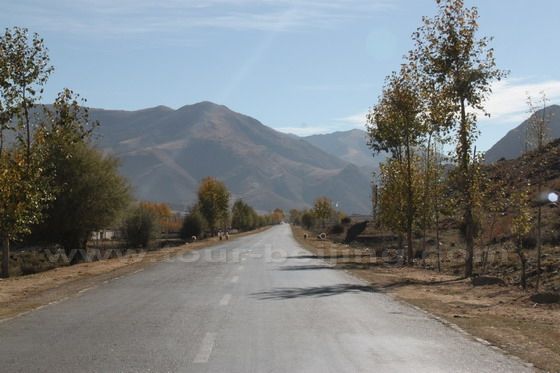
We continue to drive along the Chuanzang Highway (also called National Highway 318).
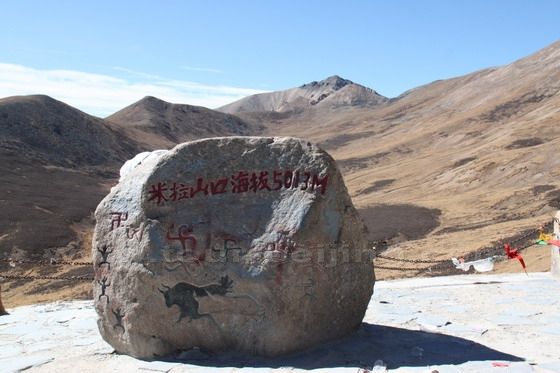
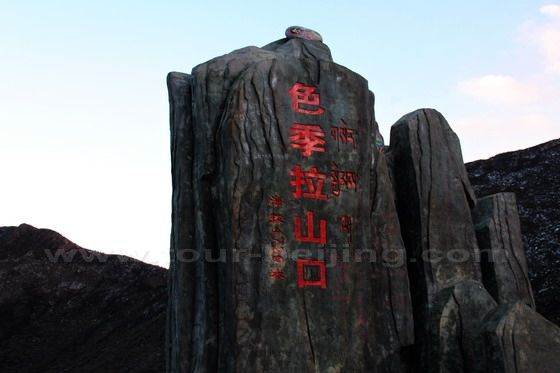
At the distance of 156km, we reach the Mila Pass (5013m), the highest point on the way from Lhasa to Ranwu.
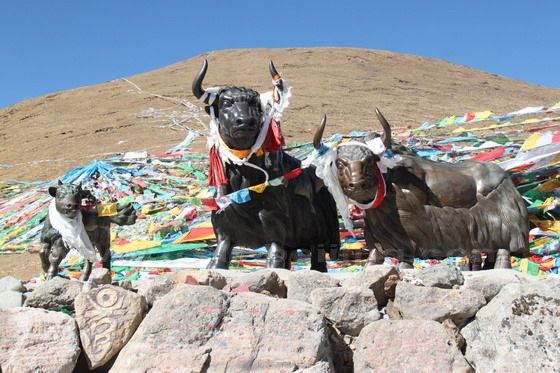
All the passing by travelers stop for a break at the pass. Three statues of Yaks stand high on the platform by the Mila Pass to welcome visitors coming afar.
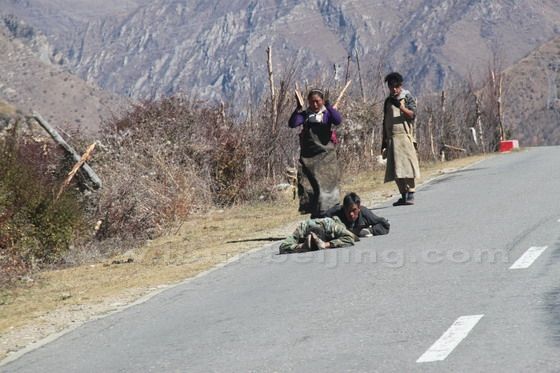
Driving down the pass, we are amazed to see the Tibetans prostrating all the way to Lhasa.
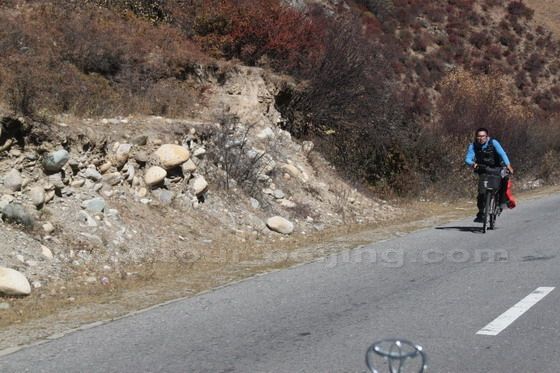
On the route, we meet quite a few travelers challenging themselves by cycling on the high elevation paved highway.
he Mila Pass is the division line between the Lhasa River and the Nyang River. The Nyang River is 307.5 km long and originates at 5,000 meters above the sea level from the Cuomuliangla, west of the Mila Mountain.
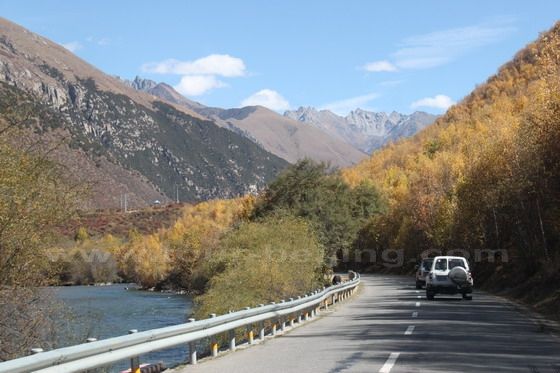
The river meets the Yarlung Tsangpo in Cemeng, Nyingchi. So from Mila Pass, the river on our left side is not Lhasa River, instead, it is the beautiful Nyang River. Escorted by Nyang River and colored by the autumn leaves, we continue to drive to our destination today – Lulang Town.
At the distance of 262km (within Gongbogyamda County), we get off at the sight of the massive Rock Pillar ( sea-level 3600m ) in the middle of the Nyang River. The Rock Pillar has a beautiful Chinese name – 中流砥柱 which implies a mainstay or a tower of strength.
At the distance of 410km, we pass by Bayi Town (Bayi or Bayizhen), the capital of Nyingchi County. It lies on the Nyang River at an altitude of 2994 metres. It is a characterless new town built on the ancient village of Drakchi.
Nyingchi, which literally means “throne of the sun” in Tibetan has a relatively lower altitude bestowed with the green mountain slopes, snow-capped peaks and crystal-clear rivers. Nyingchi is dubbed as “Switzerland of Tibet”. The county boasts the Namjiagbarwa Peak, and the Yarlung Zangbo Great Canyon, and the abundant nature resources.
At the distance of 457km in the late afternoon, we reach the Serjila Pass (the Seche La Pass) at the elevation of 5020m where we are lucky to see the golden summit of Namcha Barwa Mountain (or Namchabarwa and the Namjiagbarwa Peak). Namchabarwa (7787m) is selected as the most beautiful mountain in China.
The Serjila Pass, or the Seche La Pass (5020m)
The golden summit of Namcha Barwa Mountain
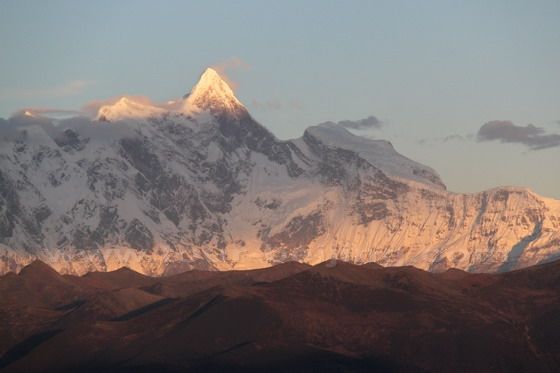
At the distance of 482km, we get to Lulang Town. Today we stay overnight at Lulang Town. Lulang is a two-horse town, nestled between the mountainous peaks with the vast expanse of trees (dubbed as Lulang Forest Sea). The so called town is a handful of basic houses and bungalows lined along the Chuanzang Highway.
Early next morning, we have a stroll around the two-horse town before continuing to drive to our destination of Ranwu today.
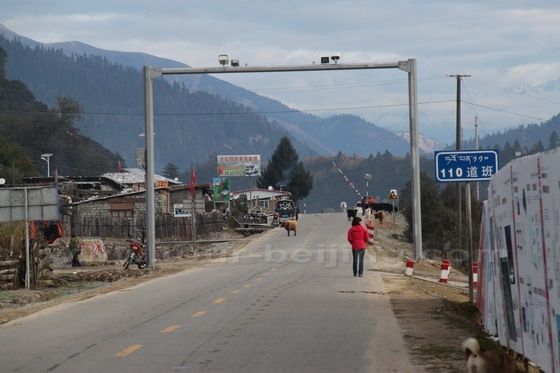
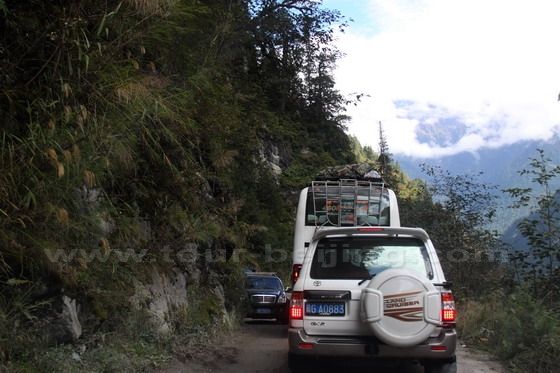
Lulang is a two-horse town From Lulang Town to Ranwu Town, we have to pass through the most dangerous road on the way – Tongmaitianxian (Tongmai Dangerous Road), which is very dangerous with the average width ranging from 6m to 7m, difficult for two vehicles to pass in opposite directions.
We successfully drive along the death road – Tongmaitianxian.
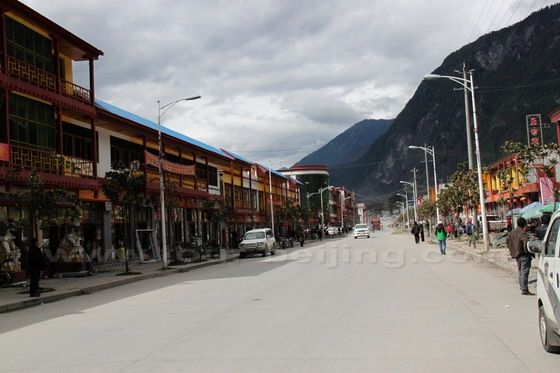
We choose the Tongmai Town for lunch. Tongmai is a booming town teeming with inns and restaurants.
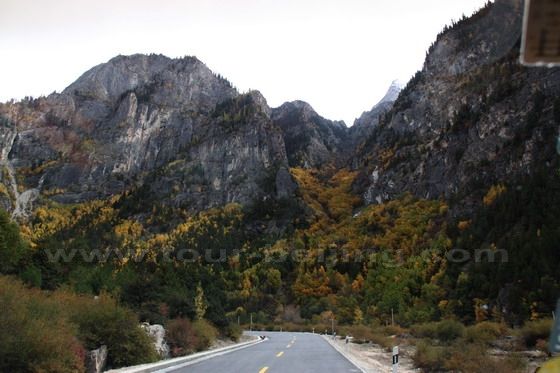
About 30km to the west of our final destination of Ranwu, we turn to the south driving along the mountain road, then change for a horse ride and get to the foot of the most beautiful glacier in China – Midui Glacier with various styles and beautiful conformation. It is a rare natural wonder.
The most beautiful glacier in China – Midui Glacier
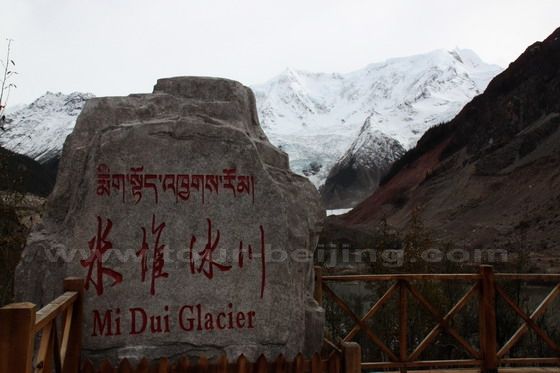
Midui Glacier Midui Glacier is a rare natural wonder
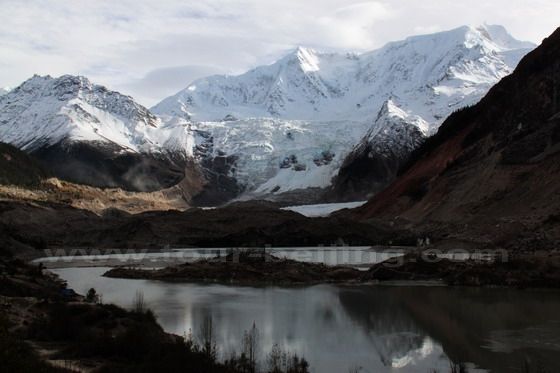
Before we reach our final destination of Ranwu Town (Rawa Town) at the distance of 768km from Lhasa, we visit the Ranwu Lake (Rakwa Tso) which has the reputation of “Swiss Landscape”.
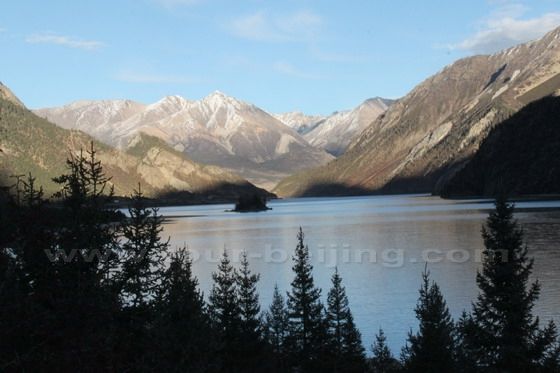
It is wonderful combination of the Swiss Alps snow peaks and glaciers. The melted snow and ice is the water source for the lake.
Stay overnight in Ranwu Town at the distance of 768 from Lhasa.
If you don’t want to go the do-it-yourself route and prefer the hassle-free escorted tours, here are some options for guided tours to Lhasa:
Share a question or note for this guide. Comments are reviewed before publishing.
Hand-picked routes matched from this article's destination clues, tags, and categories.
Use these attraction notes to connect nearby sights with tours, destination guides, and planning articles.
Continue planning with practical Beijing guides selected from similar places, themes, and travel questions.
Subscribe to receive Beijing travel ideas and tour updates.