
Call a local advisor
+86 186 1196 4400Email our team
[email protected]Tour Beijing Journal
Plan your Chengdu Tour or Sichuan tour in autumn? With Chengdu as its...
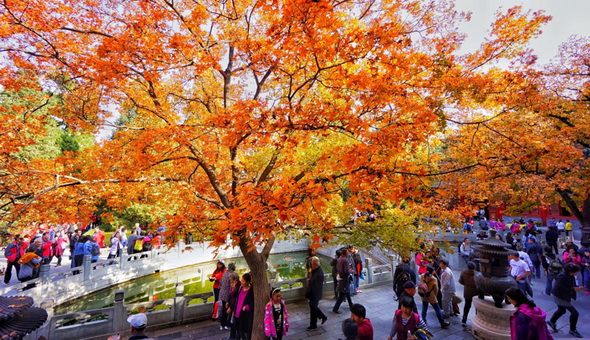
The people in Sichuan are lucky to be able to appreciate the pleasant visual stimuli brought by the change of the four seasons - flowery spring, green summer, colorful autumn and cold winter. Of all the the seasons, the short and glorious autumn is most intoxicating.
With huge different terrains and topographical features, Sichuan's autumn is long in time and extended in space. Starting from the early October, Sichuan's autumn colors morph from Qinghai-Tibetan Plateau to Chengdu plain.
In the early part of October, the forests on the mountains at the altitude of 3500 m start to turn yellow, Daocheng's red meadows, Xinduqiao's poplar trees and the fall foliage in Jiuzhaigou.
In late October and early November, the mountains at the sea level of 2000 m gradually enter the colorful season - Heishui, Miyaluo, and Guangwushan; In November, with the fading of the plateau, Sichuan's basin and its surrounding mountains usher in the magnificent season - yellow ginkgo trees blanket the streets in the cities .
Sichuan is absolutely one of the best provinces to see fall foliage in China. If you happen to visit Sichuan in autumn, we are going to reveal you the best places to see autumn leaves in Sichuan.
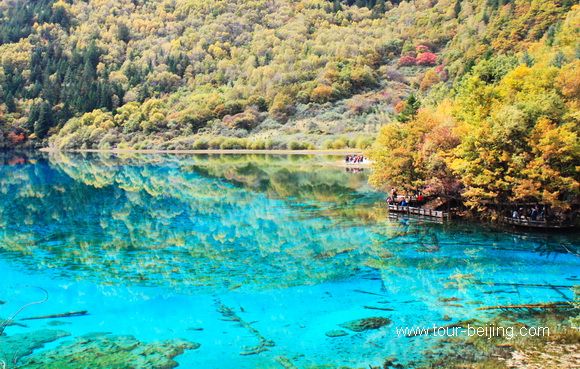
Jiuzhaigou Valley enjoys its most beautiful appearance in fall. The sky is bright and clear. The colorful leaves are reflected on the bright and clear lakes and fallen leaves are floating on the surface of water. Your eyes are filled with the most beautiful view of the natural world. You will be surprised at the masterpiece by nature! By the way, The difference in temperature between day and night is bigger in autumn, take a thick coat with you.
Danba County is located in the west of Sichuan and east of Ngawa Tibetan and Qiang Autonomous Prefecture. Danba town is about 137 km north of Kangding, 368 km west of Chengdu. Venture to east of Danba, you enter Siguniang Scenic Area and Jiuzhaigou National Park; to the south, you may enter Kangding and Hailuo Glacier Park.
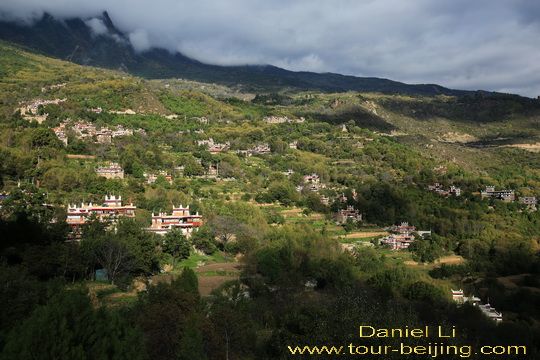
The town itself is somewhat grubby and forgettable, the surrounding cluster of watching towers, Tibetan villages and Daduhe River Gorge are what you seek after. The ancient stone Qiang watchtowers are perched among the villages overlooking the Daduhe River ( Dadu River). There are quite some nice Tibetan villages around here.
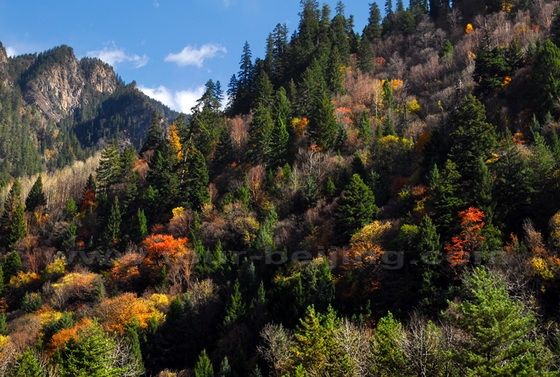
The picturesque Tibetan village known as Jiaju Tibetan Village is the best place in Danba to enjoy the soul-recharging autumn colors - all kinds of maple trees, yellow birch trees, golden poplar trees and green pine trees, presenting a magnificent palette against blue sky and white clouds.
Yading Nature Reserve is located within Riwa Township, Dacheng County, in the south of Garze Tibetan Autonomous Prefecture, Sichuan. Yading is oft-lauded as “The last piece of pure land in the water-blue planet”. Yading and Dacheng are often put together and known as the last Shangri-la.
The Yading Nature Reserve mainly comprises three holy mountains known as Chenresig, Channa Dorje and Jampelyang which are all above the altitude of 6000 meters with Chenresig the highest at 6032 meters. Chenresig is often likened to the giant Buddha; Channa Dorjie as a young man and Jampelyang as a girl. The three holy mountains are just like three sacred souls, a pilgrimage place for Tibetans.
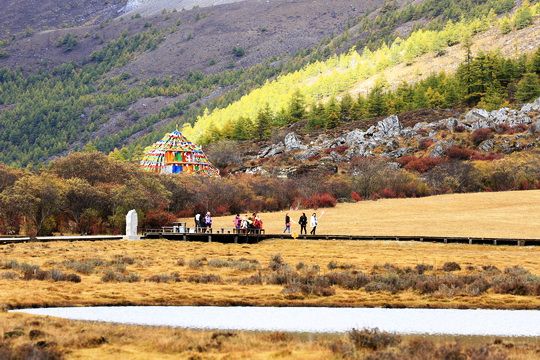
Besides the three holy mountains, the reserve is also dotted with high-plateau grasslands and green lakes, like Milk Lake, Five-color Lake, Luorong Grassland and Changgu Monastery. The 12-km koral around the 6032 m Chenresig is a huge rewarding experience. If you don’t have strong legs, you may stop overnight on camping and do it next day to continue your hike.
Yading Nature Reserve is a perfect natural eco-system formed by the featured geography and natural climate. When autumn comes, Yading and Daochange become a sea of colors, a birthplace for numerous picturesque landscape photos.
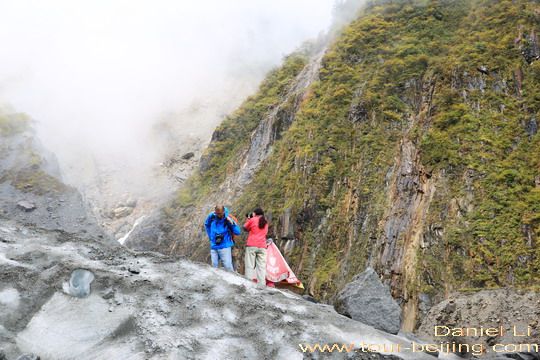
On the east slope of Gong Ga Mountain is the charming Conch Ravine with 14.3 km long glaciers. Swallow Ravine is located over 10 km to the northwest of Conch Ravine, circled by 15 peaks at the sea-level of over 5000 m. The ravines are heavily covered with forests with colorful leaves in autumn against the backdrop of snow mountains, glaciers, sometime accompanied with thin fogs, a stunning autumn hues. The best time to visit: Late October - early November.
Mt. Siguniangshan, literally " Four Girls Peaks", is located on the middle of Qiong Lai Mountain Range at the confluence of Xiaojinxian County and Wenchuan County in Ngawa Tibetan and Qiang Autonomous Prefecture, a part of UNESCO World Heritage crowned "Panda Habitat in Sichuan" .
The Mt. Siguniangshan is composed of the four shoulder to shoulder peaks from north to south for a distance of 3-5 km with the sea-level at 6250m, 5355 m, 5279 m and 5038 m. The 4 peaks are snow-shrouded all year round, like 4 elegant girls in white muslin skirts. Mt.Siguniangshan is about 245 km to the northwest of Chengdu.
The autumn hues at Shuangqiao Ravine is impressive with a backdrop of snow mountains, glaciers, meadows, forests, lakes and Tibetan villages. The red-colored pine trees blanket the mountains. Best Time to visit: Mid-October - early November.
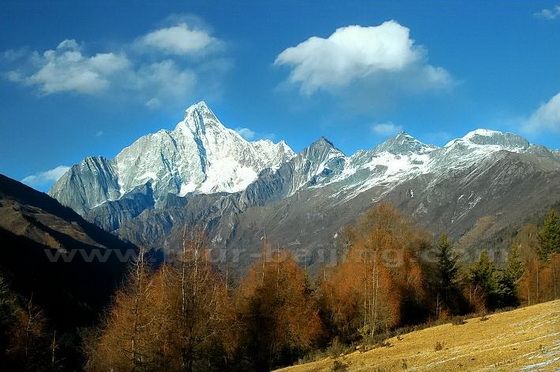
Mt. Guang Wu Shan is located 70 km in the north of Nanjiang County in Bazhong City, 460 km to the northeast of Chengdu. The main peak is at the altitude of 2500 m.
Mt. Guangwushan features flowing water and red leaves seldom seen in other provinces. When autumn comes, colorful leaves cover the ravines and mountains. The best time to go: late October - early November.
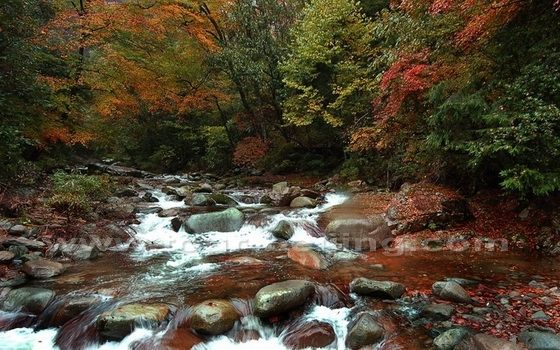
Yala Snow Mountain ( 5884m ) is located at the confluence of the three counties including Kanding, Daofu and Danba. It is a sacred mountain covered by snow all year round.
Yala Snow Mountain is peppered with over a dozen of ravines with a picturesque view. When autumn comes, the magnificent golden needle pine trees are very photogenic. The best time to go: Mid-October to early November.
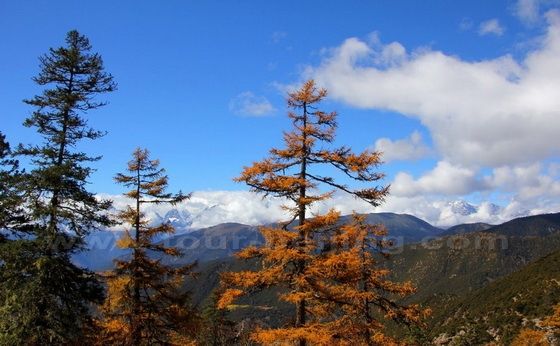
Xinduqio is a name of a small town at the sea-level of 3300 m. It is located at the conjunction of National Highway 318 , 81 km west of Kanding.
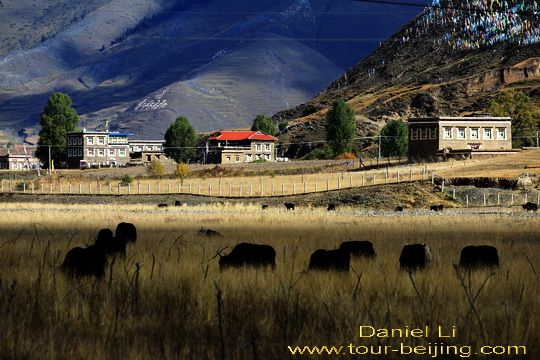
Xinduqiao is a paradise for photographers. The scenic driver along the highway near Xinduqiao is oft-lauded as " "Photographer's Corridor" with the combination of boundless meadows, winding streams, golden poplar trees and undulating mountains dotted with Tibetan villages. The best time to go: October.
Hei Shui County is located in the heart of Ngawa Tibetan and Qiang Autonomous Prefecture in Sichuan. Heishui features plentiful mountains with average altitude at 3544 m and the seat of the Heishui County at 2350 m.
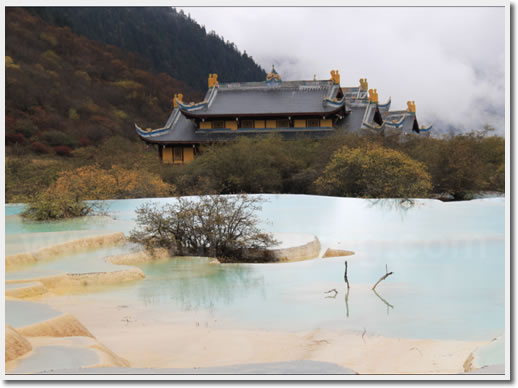
Heishui has a large area of colorful forests with its attractions scattered far away from each other. Visitors mainly go to the three places - Kalong Ravine, Naizi Ravine and Dagu Glacier. The colorful forests in the three places are more or less the same in terms of autumn hues. Comparatively Naizi Glacier area is more impressive with the backdrop of snow mountains and lakes; Kalong Ravine has multi-level waterfalls and colorful lakes.
If you don’t want to go the do-it-yourself route and prefer the hassle-free escorted tours, here are some options for Chengdu and Sichuan guided tours:
Share a question or note for this guide. Comments are reviewed before publishing.
Hand-picked routes matched from this article's destination clues, tags, and categories.
Use these attraction notes to connect nearby sights with tours, destination guides, and planning articles.
Continue planning with practical Beijing guides selected from similar places, themes, and travel questions.
Subscribe to receive Beijing travel ideas and tour updates.