
Call a local advisor
+86 186 1196 4400Email our team
[email protected]Tour Beijing Journal
Euphrates Poplar Trees Euphrates poplar (Populus euphratica), or Desert...
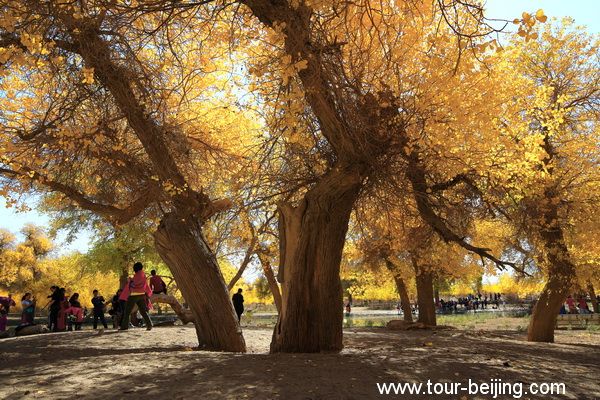
Euphrates poplar (Populus euphratica), or Desert Poplar, is an ancient species of poplar tree in the willow family. The poplar trees change colors with seasons – green in spring and summer, yellow and golden on autumn, and red in winter.
The Euphrates Poplar trees (Also known as Diversifolius Poplar and Populus ) turning yellow in the deep summer offers a great photograph opportunity, very often attracting crowds of visitors.
Populus Forest Geo-Area in Ejin Banner, Alxa League ( Alashan ) in the west of Inner Mongolia (内蒙古阿拉善盟的额济纳旗胡杨林) in China is one of the three remaining natural Euphrates Poplar Forests (Also known as Diversifolius Poplar) in the world with a total forest area of 30,000 hectares.
The other two huge areas of Euphrates Poplar Forests are Sahara Desert and Taklamakan Desert in Uygur Autonomous Region of Xinjiang of China .
The whole area becomes a sea of golden leaves, enticing a consistent flow of tourists to enjoy the amazing scenery each year. In 1992, the Ejna Banner Euphrates Poplar Forest Nature Reserve was established there.
Recently years the local governments at all levels have made great efforts building a tourist-friendly Euphrates Poplar Sightseeing District (Huyanglin Scenic Area 内蒙古阿拉善盟的额济纳旗胡杨林 in Chinese ). Now it has become a hot tourist destination for tourists and photographers who flock here to view the magnificent golden fairyland.
When you plan your Inner Mongolia Tour, or especially the West Inner Mongolia Tour, Ejina Euphrates Poplar Forests is a big draw that you should not miss.
While plan your trip to Ejina Banner for viewing Euphrates Populus , you should understand the best time for the fall foliage.
Basically the half month from October 01 through October 15 is the most ideal period for seeing the yellow and golden leaves of the Euphrates desert Populus trees in Ejina.
Located far west of Inner Mongolia and bordering Mongolia, Ejina Banner is a bit tricky to reach by taking public transport. Self-drive is the most popular mode of travel visiting the poplar forests.
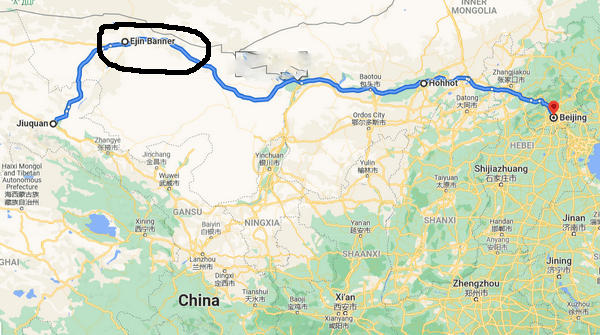
The Euphrates Desert Poplar Sightseeing District (Huyanglin Scenic Area) is just located on the east of Dalaihubuzhen Town (达来呼布镇) , the seat of the Ejina Banner Government. So you may book a hotel , or put up in a tent in the town of Dalaihubuzhen. Homestay is also a good alternative.
Entrance fee: RMB 170 ( including the shuttle bus service inside the scenic area).
The whole Huyanglin Scenic Area is about 20 km long, 15 km wide at the widest and one km at the narrowest. The whole belt is peppered with Euphrates poplar trees, red willow frees and desert bushes.
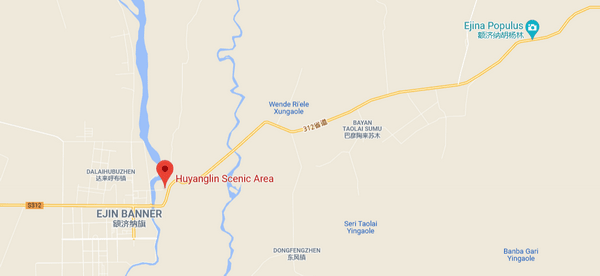
The whole desert poplar scenic area is mainly composed of eight sections – Yidaoqiao (一道桥 Bridge 1), Erdaoqiao (二道桥 Bridge 2), Sandaoqiao(三道桥 Bridge 3), Sidaoqiao(四道桥 Bridge 4), Wudaoqiao (五道桥 Bridge 5),Liudaoqiao (六道桥 Bridge 6),Qidaoqiao(七道桥 ridge 7) and Badaoqiao (八道桥 Bridge 8).
The Erdaoqiao Section (Bridge 2) is close to the west entrance ( adjacent to the town of Dalaihubu) and Badaqiao (Bridge 8) is the east end of the sightseeing belt on the east entrance to the sightseeing belt.
Basically people would take the shuttle bus first to visit the furthest section of Badaoqiao ( Bridge No.8), then either walk or take the shuttle bus back to other 7 sections.
The section No.8 (Badaoqiao) is the best place to see the sunrise over the desert. The sections No.1、2,4,7 are very interesting to visit with magnificent fall colors.
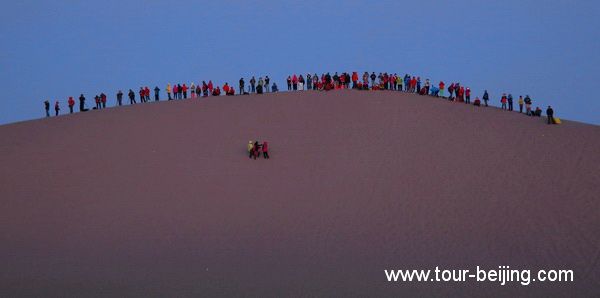
I recommend you get up early to catch the early shuttle bus from the west gate and go to the furthest section of Badaoqiao to see the sunrise, then come back to visit Qidaoqiao (No.7), Sidaoqiao (No.4) and Erdaoqiao (No.2) on a return trip.
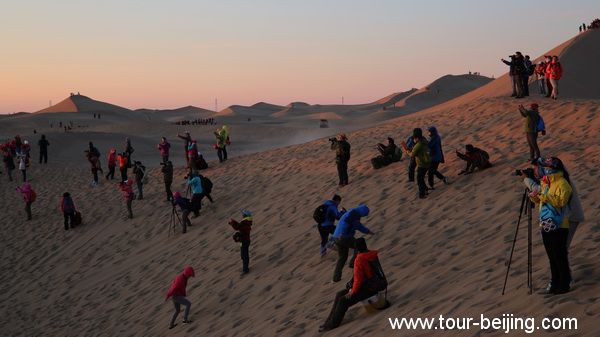
When we get to Badaqiao (No.8), we see many tourist standing on the sand dunes and waiting for the sunrise, busy shooting the rising sun with their cameras and mobiles.
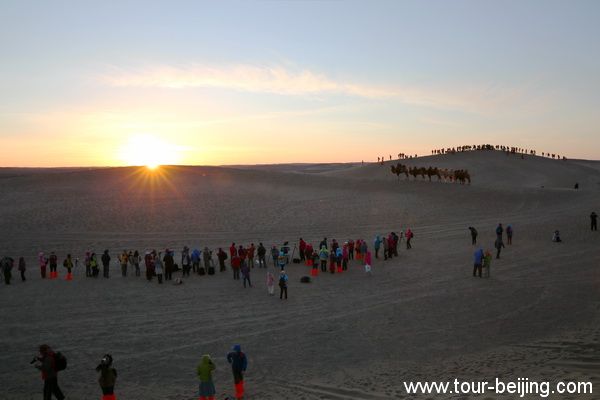
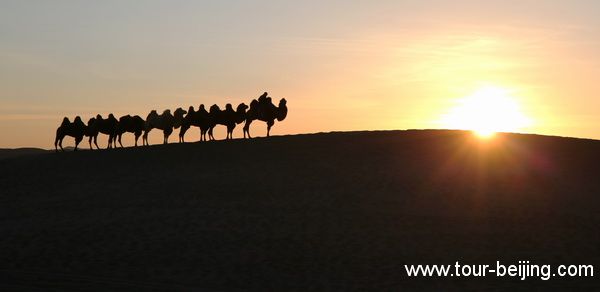
The camel man riding a camel on a high dune is going back and forth to pose for the tourists on the scene.
After seeing the sunrise at Badaqiao and simple breakfast at the foot of the sand dunes, we continue to get on a shuttle bus for the next section of Qidaoqiao. Qidaoqiao is home to the youngest poplar trees in Ejina Euphrates Poplar Forest. They are the first poplar trees to turn yellow and golden.
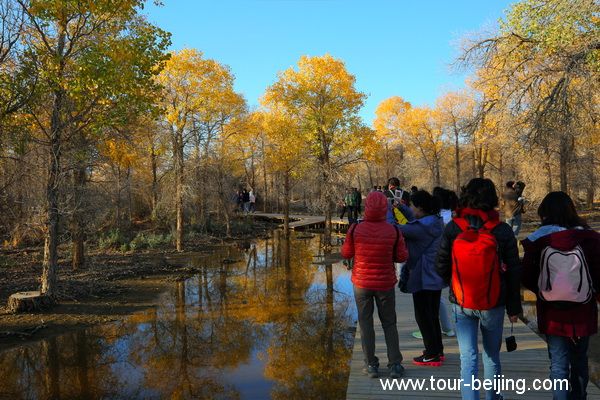
A wooden path winds through the Qidaqiao Area and you don’t have to retrace. Both entrances at Qidaoqiao have shuttle bus stations that brings you to the next destination.
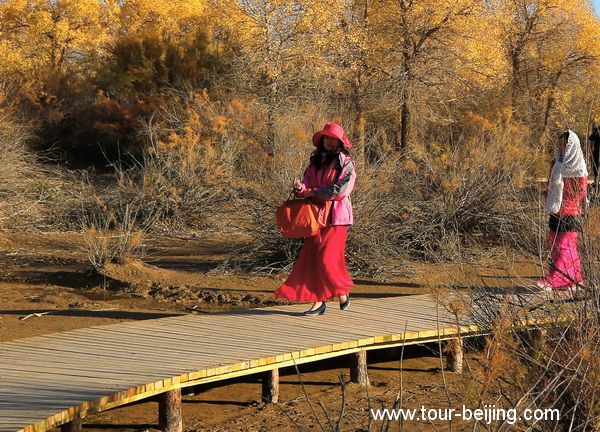
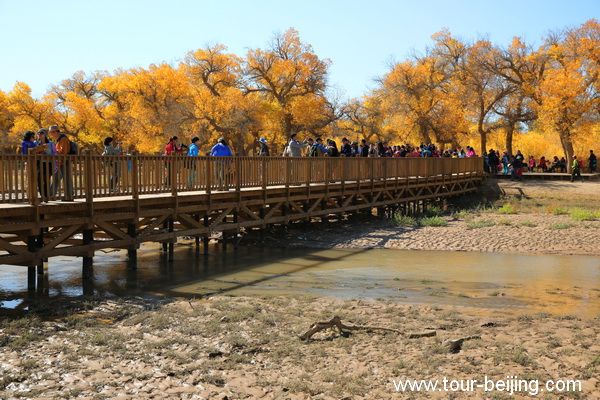
People stroll on the board walkway, enjoying the scenery on the both sides.
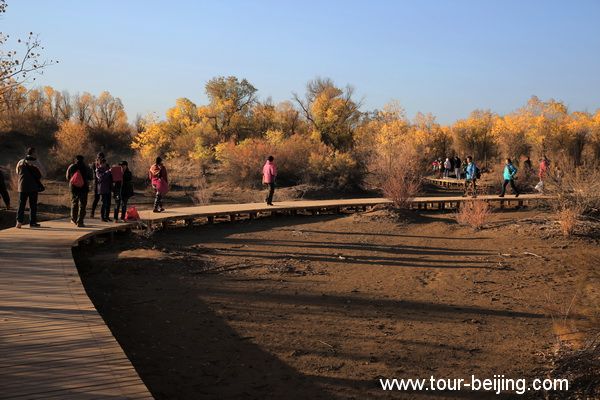
Feeling as if you were in a wonderland of the golden world.
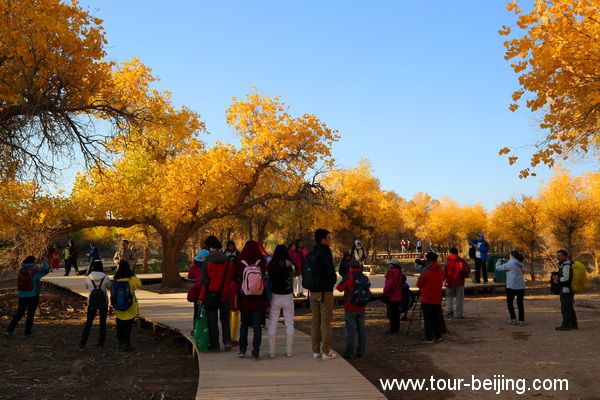
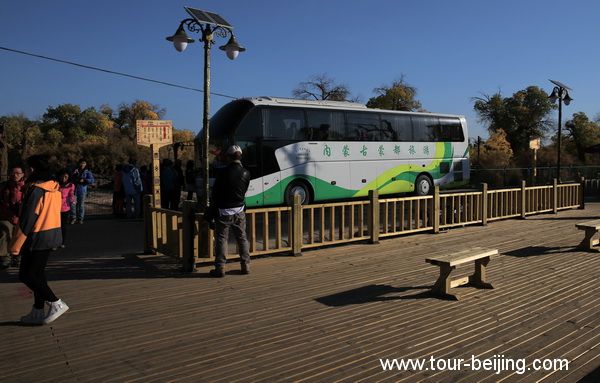
Take the shuttle bus from Qidaoqiao (No.7) to Sidaoqiao (No.4).
The Euphrates Polar trees at Sidaoqiao are old and massive, telling us a story of "audacity" in the face of the arid and hard land for centuries.
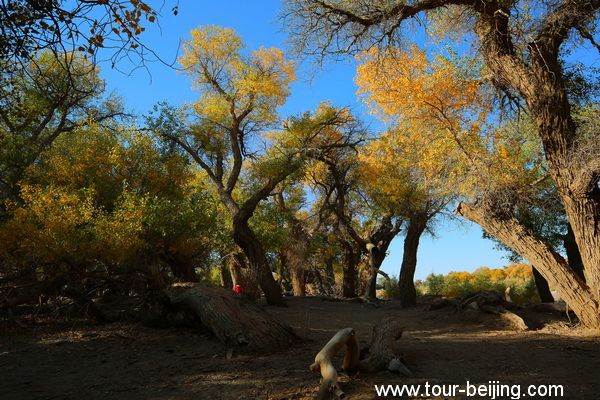
Euphrates Poplar trees are said to "exist for three thousand years – live for one thousand years, dead for one thousand years and rotten for one thousand years". Here you are able to feel the "Heroism" of the old poplar trees.
Fallen, but not collapsed
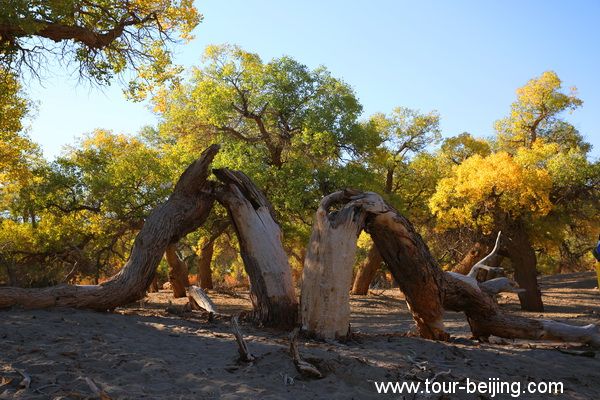
Collapsed, but not rotten.
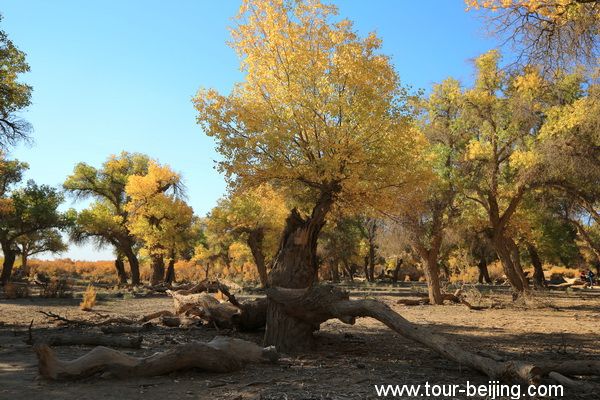
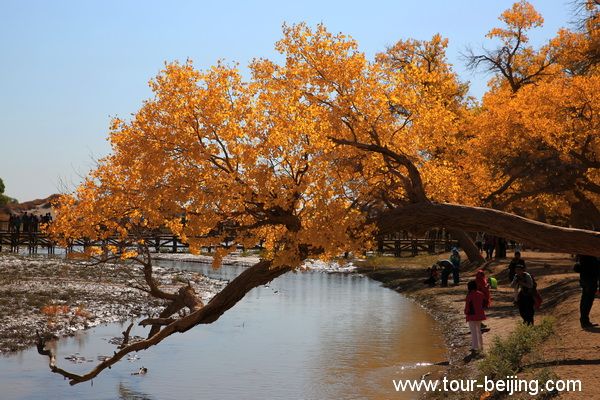
Erdaoqiao (No.2) is my favorite section to view the Euphrates Poplar trees. Here you are able to catch the wonderful views of Euphrates Poplar mirrored on water.
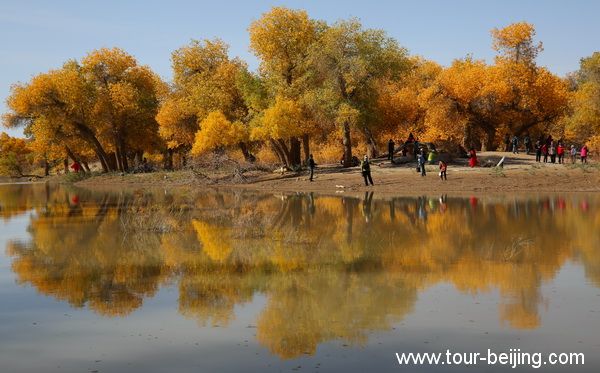
A row or Euphrates Poplar Trees are mirrored on the water, an amazing spectacle.
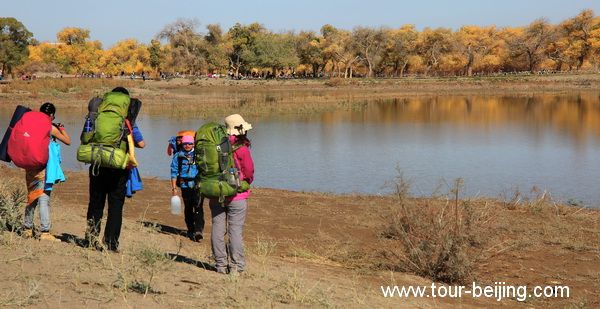
Golden Desert Poplar trees, drying river bed and wooden bridge.
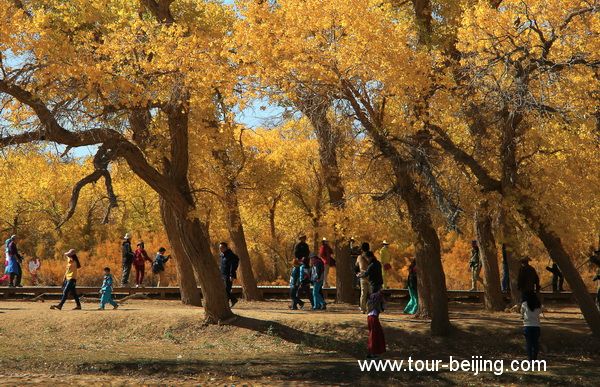
Posed in front of an old Euphrates Poplar tree by the river.
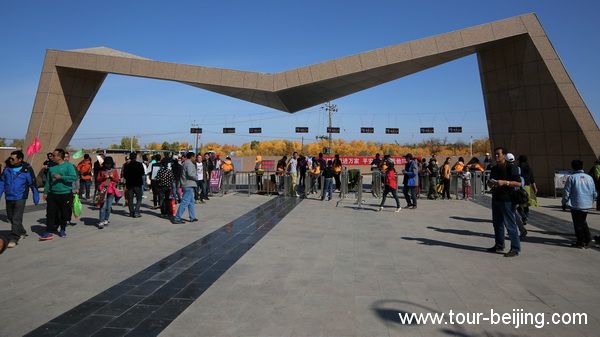
The West Entrance to Ejina Euphrates Desert Poplar Sightseeing Area.
If you don’t want to go the do-it-yourself route and prefer the hassle-free escorted tours, here are some options for guided tours to Inner Mongolia:
Share a question or note for this guide. Comments are reviewed before publishing.
Hand-picked routes matched from this article's destination clues, tags, and categories.
Use these attraction notes to connect nearby sights with tours, destination guides, and planning articles.
Continue planning with practical Beijing guides selected from similar places, themes, and travel questions.
Subscribe to receive Beijing travel ideas and tour updates.